PORTUGAL - The atlantic's hidden materpiece
PORTUGAL - The atlantic's hidden materpiece
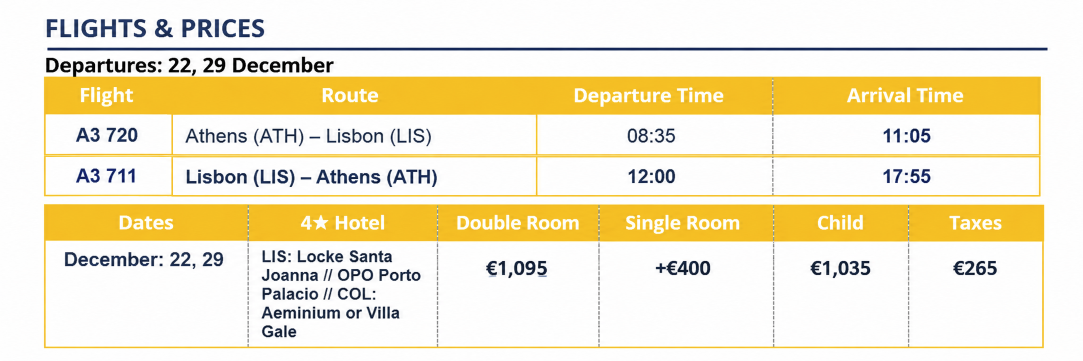
Day 1: Athens – Lisbon | First Impressions & Walking Tour
Meet at the airport for our direct flight to Lisbon (Lisboa), the captivating capital of Portugal.
Built along the banks of the Tagus River (Rio Tejo) and gracefully spread across seven hills, Lisbon is a vibrant modern metropolis of exceptional beauty, where the charm and grandeur of Portugal's former maritime and colonial empire remain deeply woven into the city's identity.
Magnificent palaces, historic monasteries, imposing castles, and elegant contemporary buildings stand alongside beautiful boulevards and picturesque squares, creating a fascinating architectural landscape.
Celebrated in countless songs and literary works, Lisbon is a city of poetry, nostalgia, and timeless character. Its atmospheric streets still seem to carry the spirit of Fernando Pessoa, one of Portugal's greatest literary figures, whose legacy remains inseparable from the city's cultural soul.
Upon arrival, transfer to our hotel for check-in and accommodation.
We then set out on a leisurely walking tour, enjoying our first introduction to Lisbon's distinctive neighbourhoods, charming streets, and enchanting atmosphere.
Overnight accommodation in Lisbon.
Day 2: Lisbon – City Sightseeing Tour & The Legacy of the Age of Discoveries
Today, we dedicate our exploration to Lisbon's magnificent landmarks, architectural treasures, and extraordinary maritime heritage.
Departing from our hotel, we travel along the beautiful, tree-lined Avenida da Liberdade (Avenue of Liberty), one of the city's most elegant boulevards, adorned with impressive examples of Portuguese architecture.
We continue towards Baixa, Lisbon's historic downtown district, renowned for its grand squares, elegant streets, and distinctive urban character.
Our next stop is the National Coach Museum (Museu Nacional dos Coches), home to one of the world's finest collections of royal carriages, featuring remarkable exhibits dating from the late fifteenth to the nineteenth century.
We then make our way to the historic riverside district of Belém, where Portugal's glorious Age of Discoveries comes vividly to life.
Along the banks of the Tagus River, we admire the iconic Belém Tower (Torre de Belém), also known as the Tower of Saint Vincent, one of Lisbon's most recognisable architectural landmarks.
Nearby stands the magnificent Monument to the Discoveries (Padrão dos Descobrimentos), a striking tribute to the Portuguese explorers who helped shape the course of world history.
In front of the monument, we discover the impressive pavement map illustrating the maritime routes followed by Portuguese navigators during the fifteenth and sixteenth centuries, when Portugal emerged as one of the world's leading seafaring powers.
Our exploration continues with an exterior guided visit to the magnificent Jerónimos Monastery (Mosteiro dos Jerónimos), one of Portugal's most important historical monuments and an enduring symbol of the wealth and influence acquired during the country's maritime expansion.
Construction began in 1501 and continued for approximately a century, with the project famously supported by revenues associated with the lucrative spice trade, including the so-called pepper tax.
The monastery is closely associated with the legendary explorer Vasco da Gama, who spent the night before his historic voyage to India in prayer at the earlier religious sanctuary that once stood on this site.
Considered the finest expression of Manueline architecture, Portugal's distinctive and richly ornamental architectural style, the monastery combines intricate stone carvings, maritime symbolism, and magnificent religious artistry.
Its church, Santa Maria de Belém, houses the tombs of several prominent figures from Portuguese history, including King Manuel I, Vasco da Gama, and the celebrated poet Luís de Camões. The literary legacy of Fernando Pessoa is also closely associated with Lisbon, although his tomb is located within the monastery's cloisters.
Together with Belém Tower, the Jerónimos Monastery is recognised as a UNESCO World Heritage Site, reflecting its exceptional historical and architectural significance.
Our guided sightseeing tour concludes here.
We recommend spending some additional time exploring the charming Belém district and, above all, indulging in its most celebrated culinary speciality: the irresistible Pastéis de Belém.
These delicious Portuguese custard tarts are best enjoyed at the district's legendary historic pastry shop, where the traditional recipe has delighted visitors for generations.
For the afternoon, we suggest visiting the impressive São Jorge Castle (Castelo de São Jorge), perched above the city and offering spectacular panoramic views across Lisbon's rooftops and the Tagus River.
Continue with a leisurely stroll through the picturesque streets of Alfama, Lisbon's oldest and most atmospheric neighbourhood, where narrow cobbled lanes, traditional houses, and hidden squares preserve the city's authentic character.
For another quintessential Lisbon experience, enjoy a ride aboard the famous Tram 28, which winds its way through some of the capital's most charming and historic districts.
In the evening, we recommend discovering the haunting beauty of traditional Fado music, Portugal's deeply expressive musical heritage, brought to international prominence by the legendary Amália Rodrigues.
An intimate Fado performance offers a memorable introduction to the emotion, nostalgia, and poetic spirit that define Portuguese culture.
Overnight accommodation in Lisbon.
Day 3: Lisbon – Sintra – Cabo da Roca – Estoril – Cascais | A Journey Through Portugal’s Romantic Coast
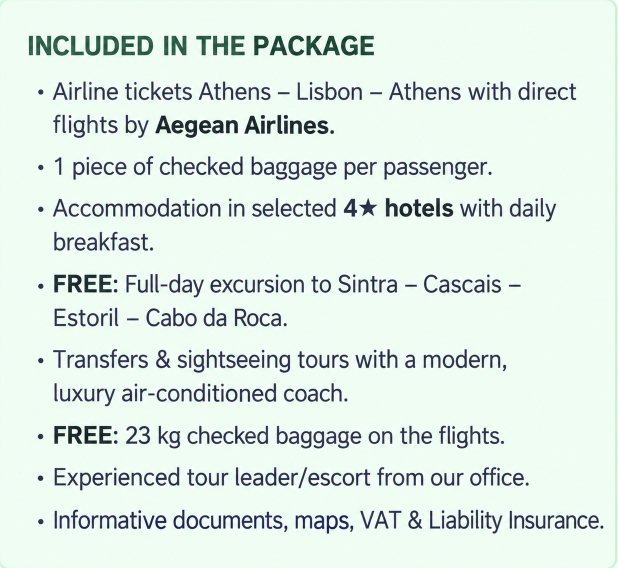
Complimentary Full-Day Excursion – Included in Your Journey
This morning, we depart for a delightful excursion beyond Lisbon, discovering some of Portugal's most enchanting landscapes, romantic towns, and elegant coastal destinations.
Our first stop is the captivating town of Sintra, a place of extraordinary beauty, where magnificent palaces, lush gardens, and romantic architecture create an almost fairytale atmosphere.
Recognised as a UNESCO World Heritage Site, Sintra has long inspired poets, artists, and travellers with its unique combination of natural splendour and architectural elegance.
At the heart of the historic town stands the impressive National Palace of Sintra (Palácio Nacional de Sintra), one of its most recognisable landmarks and an ideal starting point for discovering the town's picturesque streets, charming surroundings, and timeless character.
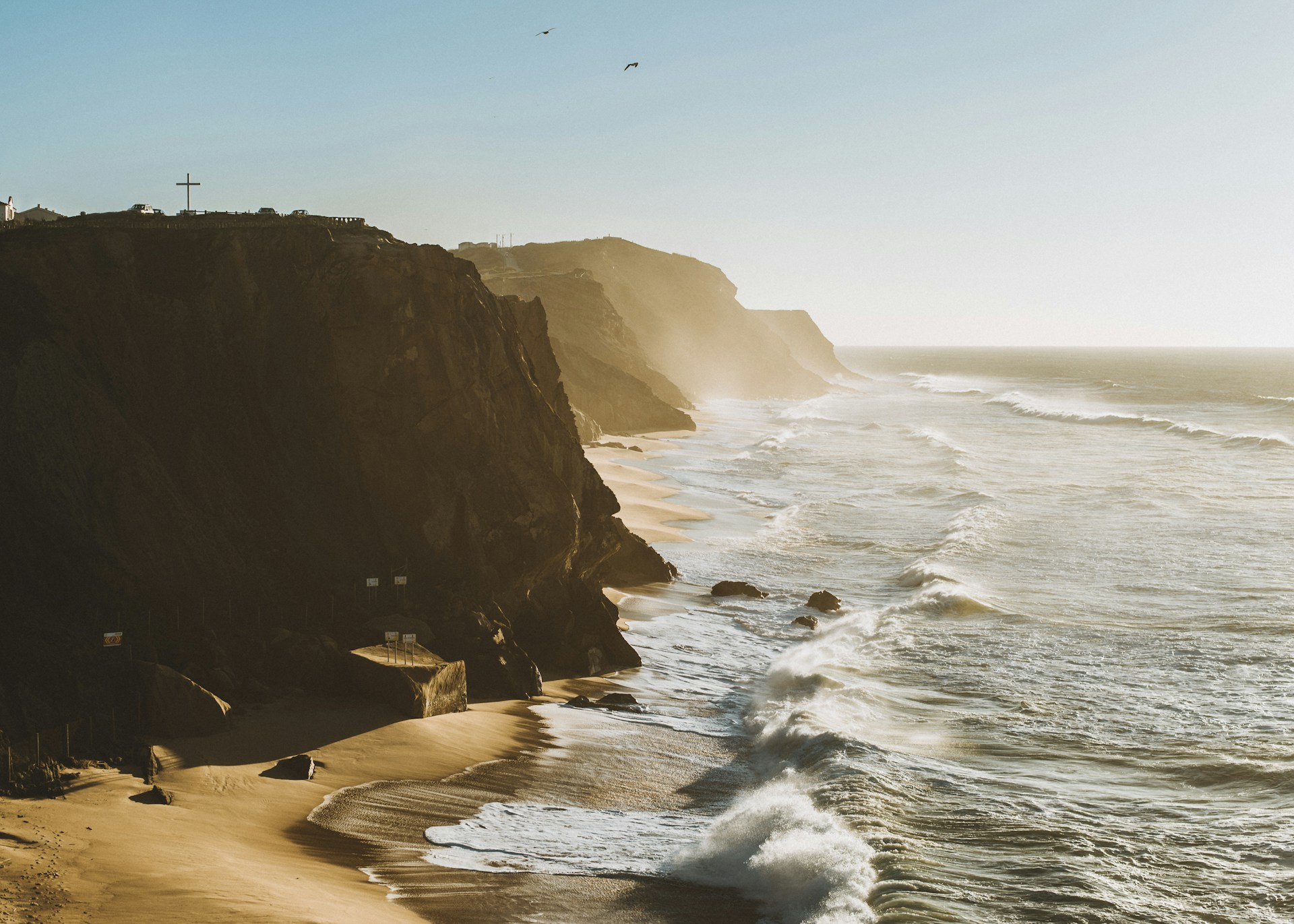
We continue towards the spectacular Cabo da Roca, the westernmost point of mainland Portugal and continental Europe.
Here, dramatic cliffs rise above the vast Atlantic Ocean, creating a breathtaking landscape where the European continent meets the endless horizon.
The celebrated Portuguese poet Luís de Camões immortalised this extraordinary setting as “the place where the land ends and the sea begins.”
Standing at this remarkable geographical landmark, surrounded by the raw beauty of the Atlantic coastline, is an unforgettable experience.
Our journey then takes us through the sophisticated seaside resort of Estoril, renowned for its elegant villas, prestigious atmosphere, and famous casino.
Long associated with European aristocracy and international high society, Estoril retains an unmistakable sense of coastal glamour.
We continue to neighbouring Cascais, where we enjoy a short stop in one of Portugal's most charming seaside towns.
Originally a modest fishing village, Cascais gained prominence during the nineteenth century when the Portuguese royal family chose it as a summer retreat.
Over time, it developed into an elegant coastal destination, celebrated for its picturesque harbour, beautiful beaches, refined atmosphere, and inviting streets.
Today, Cascais remains one of Portugal's most popular and attractive seaside resorts, effortlessly combining its maritime heritage with contemporary sophistication.
Following our excursion along Portugal's magnificent Atlantic coast, we return to our hotel in Lisbon.
Overnight accommodation in Lisbon.
Day 4: Lisbon – Óbidos – Nazaré – Fátima – Porto | Medieval Charm, Atlantic Splendour & Sacred Heritage
This morning, we depart Lisbon for a fascinating journey through Portugal's historic heartland, discovering enchanting medieval towns, spectacular Atlantic coastal scenery, and one of the world's most revered pilgrimage destinations.
Our first stop is the beautiful fortified town of Óbidos, one of Portugal's most picturesque medieval treasures.
Encircled by ancient defensive walls and crowned by an impressive castle, Óbidos enchants visitors with its narrow cobblestone streets, whitewashed houses, colourful flowers, and timeless atmosphere.
Long associated with artistic inspiration and cultural creativity, this charming town holds a special place in Portuguese royal history.
For centuries, Óbidos was traditionally presented as a wedding gift to the queens of Portugal, a testament to its exceptional beauty and prestige.
We continue to the magnificent coastal town of Nazaré, one of the most celebrated seaside destinations along Portugal's Silver Coast (Costa da Prata).
Renowned for its expansive sandy beaches, dramatic Atlantic scenery, and vibrant maritime traditions, Nazaré has become internationally famous for its extraordinary ocean waves.
These immense Atlantic swells attract some of the world's most adventurous surfers, transforming the coastline into a spectacular natural arena.
Beyond its remarkable surfing heritage, Nazaré is equally celebrated for its welcoming atmosphere and excellent gastronomy, with numerous traditional restaurants serving delicious Portuguese cuisine and fresh seafood.
Our journey then takes us to Fátima, one of the most important Roman Catholic pilgrimage destinations in the world.
The town's extraordinary religious significance dates back to May 13, 1917, when three young shepherd children reported witnessing an apparition of the Virgin Mary.
According to their accounts, the Virgin Mary announced that she would appear at the same location on the thirteenth day of each month until October, revealing a series of messages that later became known as the Three Secrets of Fátima.
The events, widely associated with the Miracle of Fátima, became the subject of both profound religious devotion and historical debate.
While millions of believers regard the apparitions as sacred events, critics have also examined their political and social significance, particularly in relation to the Catholic Church's influence in twentieth-century Portugal.
The pilgrimage gained further prominence during the era of António de Oliveira Salazar, whose authoritarian regime maintained close ties with the Catholic Church.
Today, Fátima welcomes millions of pilgrims and visitors, remaining an internationally recognised centre of faith, spirituality, and religious heritage.
During our visit, we explore the magnificent Basilica of Our Lady of the Rosary of Fátima, one of the sanctuary's most important religious landmarks.
We also visit the sacred Chapel of the Apparitions, built at the site traditionally associated with the Virgin Mary's appearances to the three shepherd children.
Our exploration continues to the impressive Basilica of the Holy Trinity, a striking example of contemporary religious architecture designed by the distinguished Greek architect Alexandros Tombazis.
Its elegant modern design and monumental interior offer a fascinating architectural contrast to the sanctuary's more traditional buildings.
Following our visit, we board our coach and continue north towards Porto, one of Portugal's most captivating and historically significant cities.
Beautifully situated along the Douro River, Porto welcomes us with its picturesque setting and distinctive architectural character.
Upon arrival, transfer to our hotel for check-in.
Overnight accommodation in Porto.
Day 5: Porto – City Sightseeing Tour | Riverside Elegance, Architectural Heritage & the World of Port Wine
Today, we discover the captivating city of Porto, Portugal's second-largest city after Lisbon and one of the country's most atmospheric destinations.
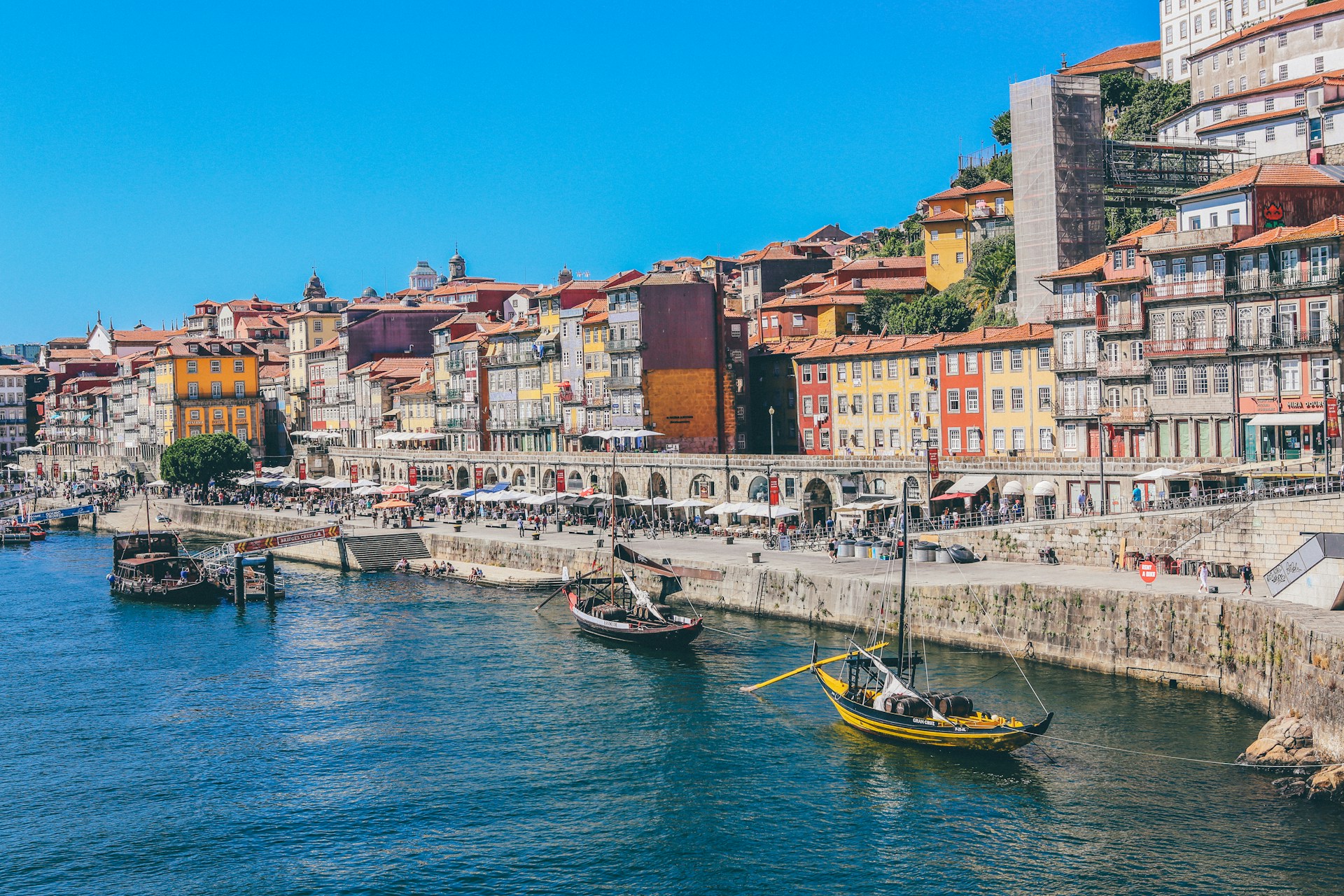
Rising gracefully along the northern bank of the Douro River, whose name is traditionally associated with gold, Porto stretches towards the river's meeting point with the Atlantic Ocean. Its picturesque hillside setting, colourful architecture, and rich maritime heritage create an unmistakably distinctive character.
Recognised as a UNESCO World Heritage Site since 1996, Porto's historic centre is a remarkable blend of architectural splendour, centuries-old traditions, and vibrant urban life.
Our sightseeing tour begins with an exploration of the city's enchanting historic centre, where elegant façades, narrow streets, and magnificent buildings reveal the legacy of Porto's prosperous commercial past.
We continue towards the banks of the Douro River, one of the city's most celebrated landmarks and an essential part of its identity.
Here, we discover the fascinating history of Porto's famous bridges, admire the picturesque rows of colourful riverside houses, and observe the traditional rabelo boats (barcos rabelos), once used to transport barrels of Port wine along the Douro.
These distinctive wooden vessels remain enduring symbols of the region's centuries-old winemaking heritage.
Our exploration continues with a visit to the magnificent Palácio da Bolsa (Stock Exchange Palace), one of Porto's most impressive architectural treasures.
Construction of this monumental building began in 1842, commissioned by the city's influential merchant community to accommodate the Commercial Association and institutions connected with commercial affairs.
Later associated with Porto's stock exchange, the palace reflects the city's historic economic importance and the wealth generated by its thriving international trade.
Today, this magnificent landmark welcomes visitors for guided tours and hosts prestigious official ceremonies and cultural events.
In the afternoon, enjoy some leisure time discovering Porto at your own pace.
We recommend crossing to the opposite bank of the Douro, where the charming waterfront of Vila Nova de Gaia offers spectacular views towards Porto's colourful historic skyline.
Alternatively, take a ride aboard the cable car, enjoying breathtaking panoramic views over the river and its iconic bridges, particularly beautiful as the sun begins to set.
For those wishing to experience Porto from a different perspective, an optional Douro River cruise can be arranged with the assistance of our tour leader.
Gliding along the river offers an unforgettable opportunity to admire the city's magnificent bridges, historic waterfront, and striking architectural landscape.
You may also choose to visit one of the region's renowned Port wine cellars, where you can discover the traditions behind the production of the world-famous Vinho do Porto and enjoy a tasting of this celebrated Portuguese wine.
Following an enriching day of cultural discoveries, architectural beauty, and riverside experiences, we return to our hotel.
Overnight accommodation in Porto.
Day 6: Porto – Braga – Guimarães – Porto | Sacred Landmarks & the Birthplace of Portugal
Today, we embark on a fascinating journey through the beautiful Minho region of northern Portugal, discovering two remarkable cities celebrated for their religious heritage, architectural treasures, and historical significance.
This picturesque region is also renowned for its distinctive Vinho Verde, the celebrated Portuguese wine whose refreshing character and often delicate effervescence perfectly reflect the freshness of its lush green surroundings.
Our first destination is the magnificent Bom Jesus do Monte, meaning Good Jesus of the Mount, situated approximately six kilometres east of Braga.
Considered one of Portugal's most impressive religious monuments, this extraordinary sanctuary combines magnificent architecture, beautiful natural surroundings, and breathtaking panoramic views.
Its most remarkable feature is the monumental granite staircase, an architectural masterpiece rising gracefully towards the sanctuary.
Adorned with elegant fountains, symbolic sculptures, and chapels depicting scenes from the Passion and Crucifixion of Christ, the staircase represents a remarkable expression of religious devotion and artistic craftsmanship.
Surrounded by lush greenery and commanding spectacular views over the surrounding countryside, Bom Jesus do Monte offers an unforgettable combination of spiritual atmosphere and architectural grandeur.
We continue to the historic city of Braga, often referred to as the Religious Capital of Portugal.
One of the country's oldest cities and an important centre of Christianity for centuries, Braga is home to an exceptional collection of religious monuments and historic landmarks.
During our visit, we explore the magnificent Braga Cathedral (Sé de Braga), widely regarded as the oldest cathedral in Portugal.
Its impressive architecture reflects centuries of artistic and religious development, bringing together different architectural influences that reveal the city's rich historical legacy.
Beyond its religious significance, Braga is a vibrant and welcoming city, characterised by broad avenues, beautiful fountains, elegant public spaces, and a lively atmosphere where centuries-old traditions coexist naturally with contemporary life.
Our final destination is the enchanting city of Guimarães, affectionately known as the Birthplace of the Portuguese Nation.
Closely associated with the foundation of Portugal and traditionally regarded as the country's first capital, Guimarães occupies a unique place in Portuguese history.
During our exploration, we discover the historic tower traditionally associated with the birth of Dom Afonso Henriques, the first King of Portugal.
We also see the church where, according to tradition, he was baptised, gaining a deeper understanding of the city's connection to the origins of the Portuguese monarchy.
Our visit continues to the magnificent Palace of the Dukes of Braganza (Paço dos Duques de Bragança), an impressive aristocratic residence that reflects the power and prestige of Portugal's medieval nobility.
The city's beautifully preserved historic centre, recognised as a UNESCO World Heritage Site, is an architectural treasure of atmospheric squares, charming streets, and remarkable medieval buildings.
Walking through Guimarães feels like travelling back to the earliest chapters of Portugal's history, where the foundations of the nation remain vividly present in its architecture and cultural identity.
Following our exploration of these two extraordinary northern Portuguese cities, we return to Porto.
Overnight accommodation in Porto.
Day 7: Porto – Bussaco Forest – Aveiro – Coimbra | Enchanted Woodlands, Picturesque Canals & Timeless Academic Heritage
This morning, we depart Porto for an enchanting journey through central Portugal, where magnificent natural landscapes, remarkable historical landmarks, and picturesque cities reveal another captivating side of the country.
Our first destination is the extraordinary Bussaco Forest (Mata Nacional do Buçaco), a protected woodland of exceptional natural beauty, recognised as a National Monument of Portugal.
The history of this remarkable sanctuary dates back to the early seventeenth century, when Carmelite monks established a monastery within its peaceful surroundings.
Seeking solitude and spiritual contemplation, the monks created a secluded religious retreat, where entry was traditionally restricted to women under a papal decree.
Over the centuries, they cultivated an extraordinary botanical collection, planting exotic trees and rare species brought back from distant lands by Portuguese explorers.
Today, the forest is celebrated for its magnificent vegetation, tranquil pathways, and remarkable botanical diversity, creating an almost mystical atmosphere.
Bussaco also occupies an important place in European military history.
In 1810, during the Napoleonic Wars, British and Portuguese forces fought a decisive battle here against Napoleon's army, successfully resisting its advance towards Coimbra.
Following the closure of the monastery in the nineteenth century, King Carlos I of Portugal commissioned the construction of an elaborate royal hunting retreat on the site.
However, the monarch never had the opportunity to enjoy the completed residence, as he was assassinated before its completion.
The magnificent building was eventually transformed into the prestigious Bussaco Palace Hotel, a luxurious five-star property renowned for its extraordinary architecture and romantic setting.
After admiring the forest's natural splendour and fascinating heritage, we continue towards the charming city of Aveiro.
Often described as the Venice of Portugal, Aveiro is celebrated for its picturesque canals, graceful arched bridges, and colourful traditional boats known as moliceiros.
These elegant vessels, once used to collect seaweed from the surrounding lagoon, have become one of the city's most distinctive symbols.
The charming waterways and inviting atmosphere make Aveiro a delightful destination, where maritime traditions and picturesque urban scenery blend beautifully.
We then board our coach and continue towards Coimbra, one of Portugal's most historically significant and culturally distinguished cities.
Beautifully situated along the banks of the celebrated Mondego River, Coimbra is renowned for its rich academic heritage, historic architecture, and enduring cultural traditions.
Our first stop takes us to the opposite bank of the river, to the grounds of the magnificent Santa Clara-a-Nova Monastery.
From this exceptional vantage point, we enjoy spectacular panoramic views of Coimbra, with its historic buildings rising gracefully above the river and the renowned university dominating the skyline.
We continue our exploration with a visit to the prestigious University of Coimbra, one of Europe's oldest and most celebrated academic institutions.
Steeped in centuries of intellectual tradition, the university has played a defining role in Portugal's cultural and educational development.
We explore its historic surroundings before descending towards the city's charming old quarter.
Our route leads us through a picturesque maze of cobbled alleyways, narrow streets, and ancient stone staircases, where Coimbra's timeless atmosphere unfolds at every turn.
Our sightseeing tour concludes at the magnificent Church of Santa Cruz Monastery (Mosteiro de Santa Cruz), one of the city's most important religious and historical landmarks.
Closely associated with the earliest chapters of Portuguese history, this remarkable monument provides a fitting conclusion to our exploration of Coimbra's extraordinary heritage.
Overnight accommodation in Coimbra.
Day 8: Coimbra – Lisbon – Athens | Farewell to Portugal
After breakfast at our hotel, we bid farewell to Coimbra and begin our return journey towards Lisbon.
Upon arrival at the airport, we proceed with check-in formalities for our return flight to Athens.
Our memorable journey through Portugal comes to an end, leaving us with lasting impressions of its magnificent cities, rich cultural heritage, picturesque landscapes, and timeless Atlantic charm.
AMENITIES
PRICE LIST